
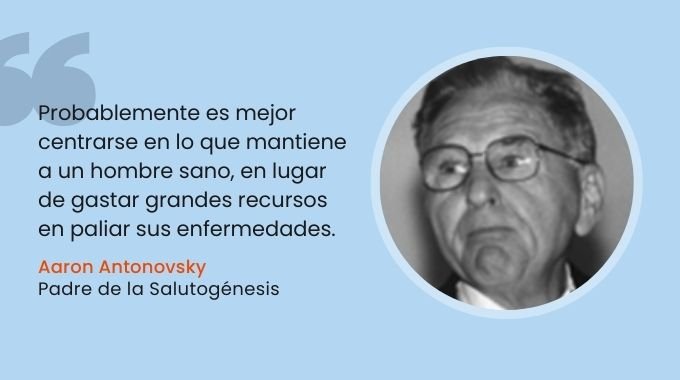
By now, you probably know us. Of course, you also know our role models in mental health for teens and life. Still, we love talking about them from different perspectives. Together, these views might one day capture the life they truly lived. Today, we want to share more about Aaron Antonovsky and his work. We hope you enjoy it!
Why Do We Talk About Aaron Antonovsky?
Antonovsky was a relentless researcher who wanted to understand the effects and impact of stress. He studied this across various situations involving deep existential changes.
He also studied how social, cultural, and economic differences impact health over time. These studies became research milestones. They provided evidence for the growing concern that industrialized societies negatively affect human mortality and morbidity. If he were alive today, I have no doubt he would be studying the impact of technology on human health.
With the 1979 publication of his Salutogénesis theory in “Health, Stress and Coping”, Aaron Antonovsky became a pioneer of Behavioral Medicine. This branch of medicine connects matter-based health sciences (like biology, physics, or chemistry) with those based on the “psyche”, soul, and social aspects (such as psychology, psychiatry, sociology, or consciousness).
About Aaron Antonovsky (Context and Brief Biography)
Antonovsky was born in Brooklyn in 1923. He had to interrupt his history and economics studies to serve in World War II. In 1945, he graduated in sociology from Yale University. There, he first encountered a rising field: medical sociology. He became a professor at Brooklyn College. In 1956, he served as Research Director for the New York State Commission Against Discrimination.
In 1960, he and his wife Helen, a developmental psychologist who joined him in some studies, emigrated to Israel. There, Aaron began researching applied social medicine in Jerusalem. He also started studying the latent impact of care communities on health. The role of institutions and community in health was one of his most relevant contributions, which he expanded in his Salutogénesis theory.
In 1972, he helped establish the school of social medicine at Ben-Gurion University of the Negev. He held the Kunin-Lunenfeld chair in medical sociology. During his twenty years there, Antonovsky developed his theory of health and illness, which he named Salutogénesis. He described this model in his 1979 book, “Health, Stress and Coping”. In 1987, he published “Unraveling the Mystery of Health”.
Valuable Contributions to Understanding Life and Health
We find Antonovsky’s studies in many different circumstances and contexts. These include teenagers facing the world outside of school, women entering menopause, and people facing retirement. He also studied patients diagnosed with cancer, multiple sclerosis, and arterial stenosis.
In all his studies, Antonovsky observed that stress is omnipresent. However, not everyone shows negative health outcomes in response to it. He noted that, instead, some people achieve good health despite being exposed to potentially disabling stressors.
In all cases, Antonovsky researched the resources that people of any age use to adapt to change. He introduced the concept of SOC (Sense of Coherence) to explain a person’s level of generalized confidence. (More details here: next post)
He operationalized his theory with the Orientation to Life Questionnaire, also known as the SOC Questionnaire. Two versions are available: a long one with 29 questions and a short one with 13. The short version is the most well-known. It has become standard in research by the international study group on Salutogénesis.
Antonovsky died in 1994, leaving a powerful legacy on the foundations of health and human development. The theory of Salutogénesis promotes the recognition of a healthy human being who can cope with the stress of successive changes. The key to overcoming adversity and gaining health is a person’s ability to face the unfamiliar and the conflicts of uncertainty, emerging stronger from those circumstances.
