
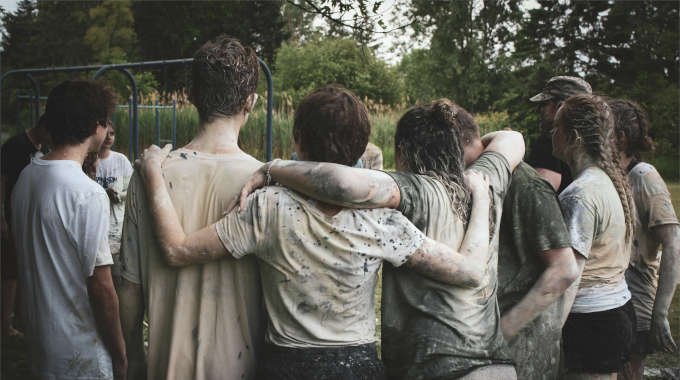
Today we explore the types of life skills, their classification, and how they manifest in daily life, such as in school, family, or the teenage experience. Understanding this structure is the first step to identifying which skills are most present and which need more attention.
With this second article, we continue our series on life skills, a key pillar for understanding and strengthening adolescent mental health. Access our previous post if you want to explore What are life skills and why do they matter in adolescent mental health?
Types of life skills
Although all life skills are interconnected, we can organize them into four main groups based on their focus and application: cognitive, emotional, social, and practical. This initial classification makes it easier to teach them in blocks and helps identify which areas need more reinforcement at each developmental stage.
🧠Cognitive skills
These skills allow us to think critically, analyze situations, and make responsible decisions. These competencies are key to fostering autonomy, self-judgment, and the ability to evaluate consequences before acting. Furthermore, at a time when the rise of AI makes it harder to discern the truth of the information we receive, deeply developing these skills is essential.
Here we can consider the following 4 skills:
- Critical thinking
- Creative thinking
- Decision-making
- Problem and conflict resolution
💓Emotional skills
As we saw in the article “How to differentiate emotions from feelings and values?”: thought and emotion form an inseparable bond. Generally, there is a very close correlation between the quality of our thoughts and our mental well-being. For this reason, it is essential to make room for developing this set of skills, as without emotional health, other skills fall short.
In this group, we can include the following:
- Managing tension and stress
- Managing emotions and feelings
- Self-awareness
- Acceptance
- Resilience
- Self-confidence
🗣️Social skills
Numerous studies conclude—and it has even been featured in Netflix series like “Live to 100: Secrets of the Blue Zones”—that the quality of our relationships directly influences our mental health (and how long we live!). This type of life skills connects us with others through respect and solidarity. They allow us to establish healthy, empathetic, expansive, and collaborative relationships with other people.
It consists of:
- Assertive communication
- Empathy
- Interpersonal relationships
- Cooperation and teamwork
- Inspiration and social commitment
📘Practical skills
Finally, existence cannot be separated from action, and this is precisely where many people struggle: they get stuck overthinking. It is important to mobilize all the energy we can to advance our mental and emotional well-being, avoiding getting trapped in ‘analysis paralysis’ and similar situations. This set of skills is reflected in daily action: they allow us to plan, act effectively, and adapt to day-to-day challenges. They are essential for personal autonomy.
Here, then, we will find the following:
- Problem and conflict resolution through organization and planning
- Creative thinking with a practical application of solutions
- Trust (in life) by working on one’s own dreams
- Acceptance and resilience for when practice does not bring the expected results
Examples of life skills in different contexts
As we can see, in practice, the types of life skills are not isolated compartments (we can already see that this last group contains many skills found in other blocks). Indeed, skills intertwine, reinforce each other, and develop in an integrated way. That is why it is so important to work on all of them in a balanced way, both at home and at school.
They are not just theoretical concepts; they manifest every day, multiple times a day (in how we think, feel, relate, and act). Below, we show you real examples of how these skills are expressed in different key contexts.
Example of how life skills are experienced in adolescents
During adolescence, life skills are essential for building identity, identifying personal assets or resources, regulating intense emotions, and establishing meaningful relationships. Some typical situations that come to mind at this age include, for example:
- A teenager who recognizes and regulates their frustration when an exam does not go well: without realizing it, they are putting emotional management and resilience into practice.
- A girl who rejects peer pressure to do something she is not comfortable with, using her critical thinking, confidence, and assertive communication.
- Or, going a bit further, when a group of students collaborate to organize a mental health awareness day (or any other kind 😋) at their school, they put social commitment and teamwork into play and practice, among other skills.
These, and many other situations, mean that students (often unconsciously) are practicing certain types of life skills that protect them against risky behaviors and promote healthy development.
Example in the educational environment
Whether we intend to or not, classrooms are privileged spaces for developing life skills, both in terms of curriculum and relationships. That is why at WHI Institute, our adolescent mental well-being solutions always include a program that incorporates their progressive and conscious practice.
Even so, beyond our proposal, we can see in these examples how different skills are put into practice:
- When a teacher encourages participation and active listening in class, it helps develop empathy and mutual respect among students.
- A leadership team that designs coexistence protocols focused on conflict mediation and dialogue.
- Students working on interdisciplinary projects that require planning, critical thinking, and real collaboration.
School does not just transmit content: it also models ways of being in the world. That is why it is important to reflect and design a strategy that truly enhances this deep work on life skills.
Beyond school: in the family and in daily life
We must remember that, before school, our first impact and interaction with life happens within the family and its most immediate context. This is where we begin to learn (or not) many of these skills. For example:
- A parent who validates their child’s emotions without judgment, fostering self-awareness, affection, and trust.
- A teenager who participates in family decisions, learning to express their opinions and negotiate with respect.
- A home where mistakes are discussed openly, understanding them as opportunities to learn, evolve, and grow together.
- If the family engages in an activity that inspires social commitment in their community, promoting shared values and purpose.
In an increasingly complex world, coexistence and the family space are the best laboratory for practicing all these skills that allow us to build our current mental well-being and our ability to face circumstances that might arise in the future.
Do you want to know the 15 life skills in depth?
In this article, we have seen how they are classified and experienced daily, but if you are interested in diving deeper into the meaning, origin, and potential of each one, we have prepared a downloadable guide with expanded definitions and inspirational resources.
